
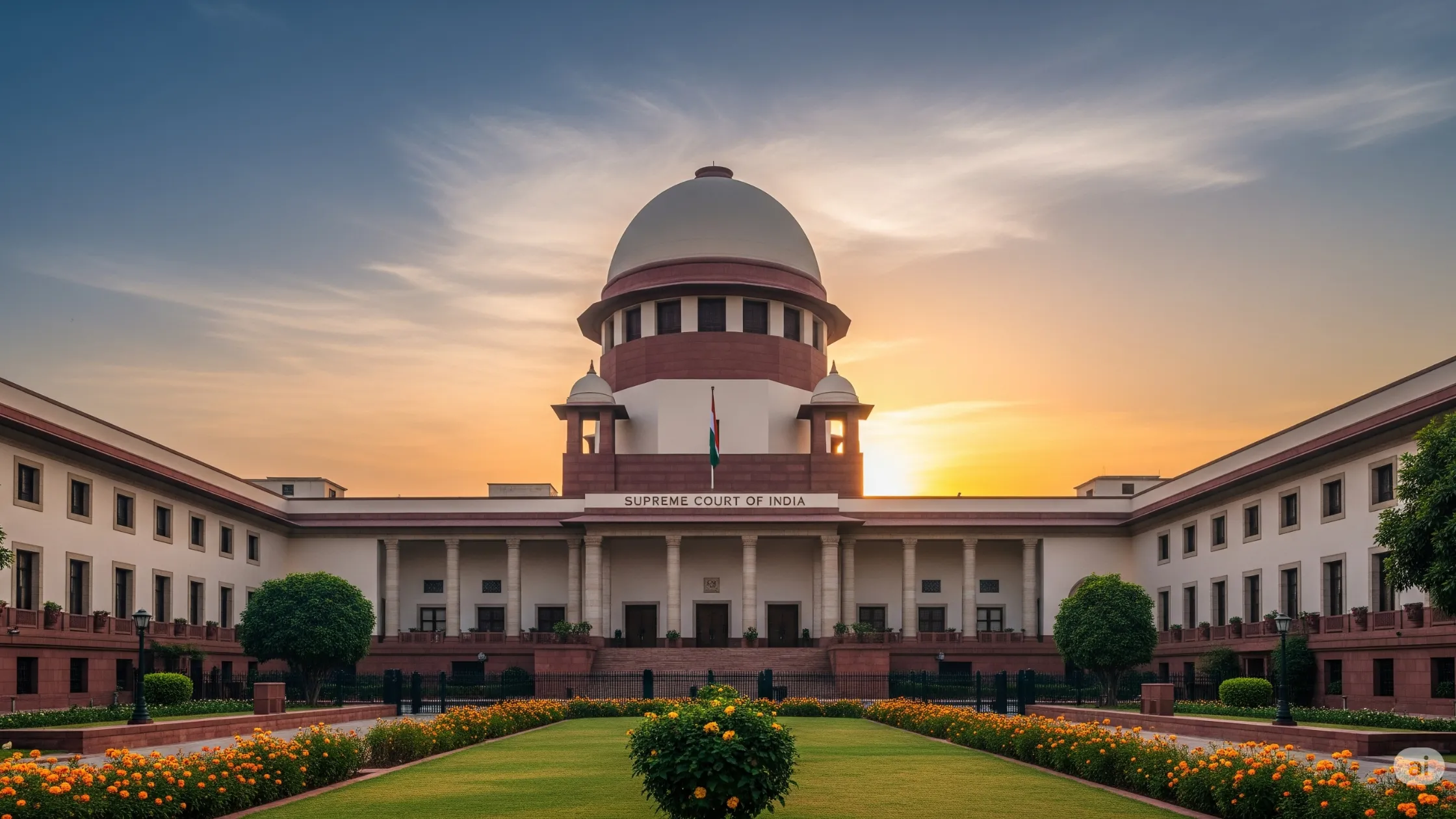
Case Citation
Gaurav Kumar v. Union of India & Ors., Supreme Court of India, (2024) INSC 558, decided on 30 July 2024.
The case of Gaurav Kumar v. Union of India is a landmark judgment delivered in 2024 concerning the right of entry into the legal profession. The Supreme Court addressed the arbitrary fee structures imposed by several State Bar Councils for the enrolment of advocates.
The decision has significant constitutional, statutory, and social implications, particularly about equality of opportunity, access to justice, and regulation of professional bodies under the Advocates Act, 1961.
At its core, the case highlights the tension between the statutory framework enacted by Parliament and the autonomy of Bar Councils to regulate the profession. It also raises questions of affordability, fairness, and substantive equality in access to the legal profession under Articles 14 and 19(1)(g) of the Constitution.
Facts of the Case
Parties Involved
- Petitioner: Gaurav Kumar, a law graduate aspiring to enrol as an advocate.
- Respondents: Union of India, Bar Council of India (BCI), and several State Bar Councils.
Relevant Facts
- The petitioner challenged the imposition of enrolment and allied fees (welfare, library, training, inspection, etc.) by State Bar Councils that far exceeded the nominal enrolment fee envisaged under Section 24(1)(f) of the Advocates Act, 1961.
- In several states, enrolment charges cumulatively ran into tens of thousands, creating barriers for economically weaker candidates.
- The petitioner argued that such levies were ultra vires the Advocates Act and unconstitutional as they violated Articles 14 and 19(1)(g).
Procedural History
The matter reached the Supreme Court through a writ petition under Article 32 of the Constitution. It was heard by a Bench led by Chief Justice D.Y. Chandrachud.
The Court considered whether the State Bar Councils had jurisdiction to levy additional compulsory charges and whether such impositions were consistent with statutory and constitutional provisions.
Legal Issues
- Whether State Bar Councils are empowered under the Advocates Act, 1961, to levy enrolment fees and additional charges beyond what is prescribed in Section 24(1)(f).
- Whether excessive enrolment fees violate Articles 14 and 19(1)(g) of the Constitution by creating unreasonable restrictions on the right to practise law.
- What remedial framework should govern future enrolment procedures to ensure compliance with statutory provisions and constitutional principles.
Court’s Decision
Holding
The Supreme Court struck down the practice of State Bar Councils charging enrolment fees beyond the statutory limits. It declared that only the fee prescribed under Section 24(1)(f) of the Advocates Act can be demanded, and all other mandatory levies are ultra vires.
Rationale
- Enrolment into the legal profession is a statutory right under the Advocates Act. Arbitrary financial barriers are unconstitutional.
- The “appropriate authority” for regulating fees is Parliament through the Advocates Act, and not State Bar Councils through practice or circulars.
- Disproportionate charges undermine equality of opportunity and violate the fundamental right to practise a profession.
Legal Reasoning
Majority Opinion (per Chandrachud C.J.)
- Interpretation of Section 24(1)(f): The provision exhaustively sets out the enrolment fee payable to State Bar Councils and the Bar Council of India. Any additional levies must have explicit statutory sanction, which was absent.
- Articles 14 and 19(1)(g): Excessive enrolment charges amount to unreasonable classification between rich and poor graduates, violating equality. They also impose unreasonable restrictions on the fundamental right to practise.
- Judicial Review: Professional bodies, though autonomous, cannot exceed statutory authority. Their regulations are subject to judicial scrutiny to safeguard fundamental rights.
Statutes and Precedents Cited
- Advocates Act, 1961: Section 24(1)(f) (enrolment fee), Section 49 (rule-making power of BCI).
- Constitution of India: Article 14 (equality), Article 19(1)(g) (right to practise any profession).
- Precedents:
- Indian Council of Legal Aid v. Bar Council of India (AIR 1995 SC 691) – regulation of Bar Councils subject to constitutional scrutiny.
- State of Gujarat v. Mirzapur Moti Kureshi (2005) – test of reasonableness under Article 19.
Impact of the Case
Legal Precedent
The judgment clarifies that arbitrary financial exactions cannot condition enrolment into the legal profession. It affirms the supremacy of the Advocates Act and Parliament’s authority over the profession.
Social Impact
The decision makes the legal profession more accessible to graduates from marginalized and economically weaker sections. It enhances inclusivity in the Bar and ensures that financial hardship is not a disqualifying factor.
Political/Institutional Impact
The ruling curtails the financial autonomy of State Bar Councils but compels them to seek alternative, transparent funding mechanisms for welfare and training without infringing statutory rights.
Analysis
Critical Analysis
The judgment is laudable for affirming equality and accessibility. It balances professional self-regulation with constitutional safeguards. However, some weaknesses remain:
Strengths
- Upholds the rule of law by restricting State Bar Councils within statutory bounds.
- Recognizes the disproportionate impact of arbitrary fees on poor graduates.
- Reinforces the constitutional right to practise law as accessible and affordable.
Weaknesses
- The Court did not provide a comprehensive framework for alternative funding of welfare activities previously financed through enrolment levies.
- It left unanswered whether candidates already subjected to excessive charges can claim restitution.
- Greater clarity on uniform fee structures nationwide could have prevented ambiguity.
Alternative Outcomes
The Court could have directed the Bar Council of India to frame model guidelines under Section 49 of the Advocates Act, standardizing permissible charges and providing for state-supported welfare funding.
Conclusion
Gaurav Kumar v. Union of India is a path-breaking ruling reinforcing the constitutional guarantee of equal access to the legal profession. By quashing arbitrary fee practices, the Court has safeguarded the rights of young graduates and restored the primacy of statutory regulation under the Advocates Act.
The case underlines the need for legislative reform, including:
- A uniform national fee policy,
- Statutory victim consultation in Bar Council funding decisions, and
- Transparent monitoring of Bar Council finances.
Ultimately, the judgment represents the Supreme Court’s continuing role in upholding equality, fairness, and accessibility within the justice system.


The jackpot opportunities here are insane. I’ve tried many sites but the vibe at bdak777 is just different and more rewarding.
Quick and easy access to my account. I appreciate how they keep the login process secure yet simple. Totally satisfied with naga777login.
I love how transparent everything is here. No hidden fees or weird rules just pure gaming fun. You should definitely visit pkck9999 for a great experience.
Incrível a experiência nesse site. O sistema é muito moderno e os pagamentos caem rapidinho na conta. Recomendo a todos! Veja brboxwin